Selection criteria
Start with the requirement you know. We design the rest of the configuration.
Low Profile Conveyor Systems compares all 14 conveyor products. If a product catches, tips or drifts and you’re not sure why, start with the Transfer & Product Control Guide.
Product size, shape and weight
Decides the conveying surface, the usable width and how the product is supported or held while it moves.
Available space and transfers
The space between operations sets conveyor length, frame height, where the drive goes and how the product crosses each handoff.
Motion and duty
Speed, load, incline, reversing, indexing and accumulation describe the work the conveyor has to do.
Operating environment
Moisture, cleaning and product exposure affect belt material, frame finish, component protection and cleaning access.
Machine integration
Mounting, electrical supply and controls connect the conveyor to your machine. Service access is part of that installed arrangement.
Design choices that affect performance
The space a conveyor needs includes the frame, belt, pulleys, product support, guides, drive and room to maintain it. How the product crosses each transfer is decided alongside the parts being carried.
A conveyor can fit the floor space and still have its drive or belt-removal path blocked by nearby equipment. We place the conveying surface, mounts and drive so there’s room left to adjust and service them.
Product width, belt width and guide clearance are three separate dimensions. Side Guides and Conveyor Stands explain how each is adjusted and mounted.
In practiceWe design around what sits on either side of the conveyor, not just the length between machines.
Controls and machine interfaces
Conveyor controls tie start and stop commands, speed changes, sensing and any indexing sequence to the surrounding equipment. Whether a given interface is compatible depends on the components selected.
See Drive Systems and OEM & Machine Integration.
Environment and product contact
Product temperature, room temperature, moisture, cleaning chemicals and what may touch the product all shape the configuration. Whether a material is suitable depends on those conditions.
Washdown & Sanitary Applications covers construction and cleaning.
Belt fatigue life
The belt bends at every pulley
Each time the belt goes round a pulley it flexes. Repeated flexing can cause fine surface cracks over time. That’s why every belt construction comes with a minimum pulley diameter from its manufacturer, and the two belong together in a conveyor specification.
Count the whole loop
The loop includes the carrying side and the return. Extra pulleys add bending points, and some layouts bend the belt the opposite way. At higher speed the belt makes more trips round the same loop each hour.
The belt’s own specification gives the minimum diameter and operating conditions.
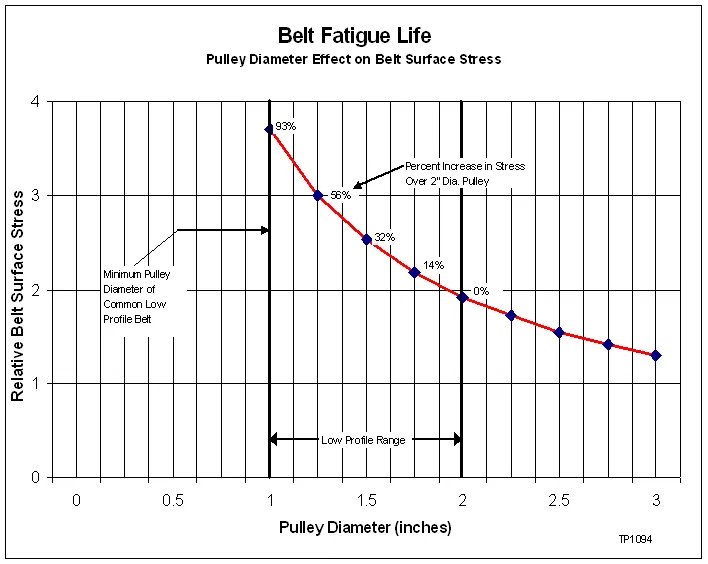
In practiceBelt life depends on the whole belt path and how fast it runs, not the belt alone.
Crowned pulleys and flat-belt tracking
Steers the belt
Crowned pulley
A slightly raised center sets up opposing side forces that keep a flat belt running true.
Limits sideways travel
Retainer or V-guide
A V-profile under the belt runs in a groove and stops it wandering by contact. Pulley alignment and belt tension still matter.
Loading and adjustment
Side loading, unloading and diverting push the belt sideways. That force might come from a product pushed on, a part diverted off, or steady contact along the run. We choose the pulley arrangement, tension and any retainer for that duty.
Tension and adjustment settings are specific to each conveyor and its instructions.
Conveyor reliability
Bearings and replaceable parts
Bearings carry belt tension even with nothing on the belt. How they’re built decides what lubrication and replacement involve. Sealed-for-life bearings need no routine relubrication.
| Bearing design | When it wears |
|---|---|
| Shaft used as the inner running surface | Wear on the shaft can mean replacing the shaft or pulley along with the bearing. |
| Self-contained bearing | Has its own inner race, so the bearing is replaced on its own. |
A bearing, pulley or drive may be a separate service part or part of a larger assembly. The product information and instructions set out which parts are replaced and how.

Belt, pulley and load
Pulley construction, belt choice and tension work together under the real load. Accumulation, inclines and reversing all add to the demand. Reliability comes from how the parts work together in your application.

Downtime and maintenance cost
Access once it’s installed
Nearby equipment can block access to the belt, guides, drive and supports. That access, the removal steps, the tools needed and any cleaning or lubrication all add to maintenance time.
Treat each changeover separately
Changing a belt, changing a holder and swapping a drive are different jobs. Each has its own procedure and its own time.
ExampleAccuVision’s two-minute belt change applies when it’s mounted on our open stand design.
Comparing end-drive conveyors
To compare end-drive quotes fairly, each one should answer for the same product, layout, load, speed and environment. We show how our proposed configuration does that.
| Compare | What it tells you |
|---|---|
| Dimensions | Belt width, usable width and length describe the conveying space. |
| Motion and load | Load and speed, with the incline and running direction. |
| Belt and components | Belt construction, pulleys, bearings, drive and controls working together. |
| Access and service | Belt removal, adjustment access, tools needed and replacement parts. |
| Quotation | Equipment and option pricing, warranty and the quoted scope. |
If figures are missing or don’t agree, we clarify them before you decide. A fair comparison ties each figure to its configuration, document revision and date.
Operating cost
Purchase and installation
The quoted equipment, options and installation work set the starting cost for an arrangement.
Use and maintenance
Maintenance labor, replacement parts, how often belts are changed and expected downtime all add up. Compare energy use only from documented consumption under similar duty.
Recorded costs describe what actually happened; estimates depend on assumptions. Working out a saving needs both sets of figures for the same period and operating hours.
For the bigger picture, Conveyor Applications connects these choices to automation, indexing, inspection and machine integration, and Industries Served shows them in production lines.